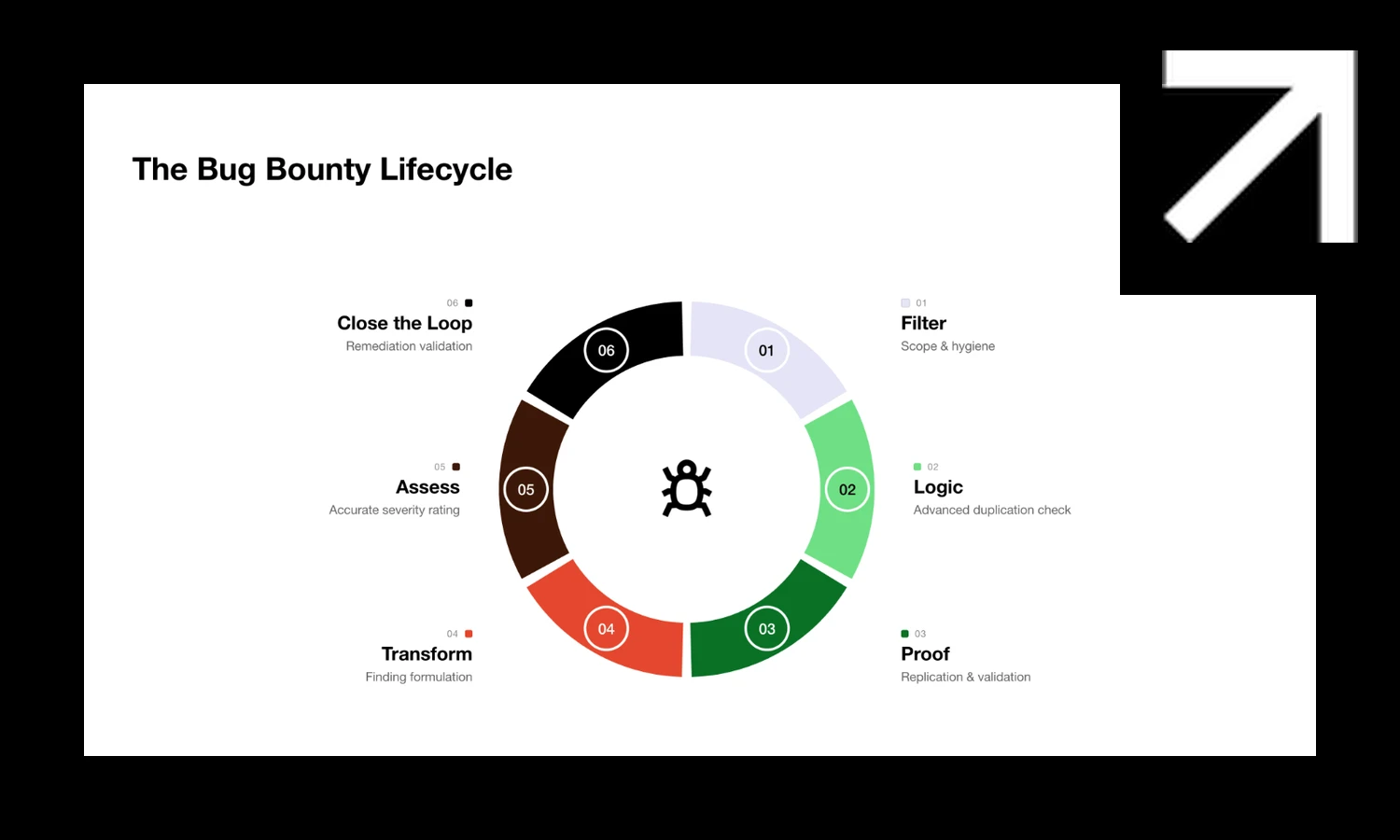
Bug bounty programs have evolved from “nice-to-have security initiatives into critical components of modern security strategies. For organizations already running—or considering—a bug bounty program, success isn’t just about launching. It’s about continuous improvement, researcher enablement, and measurable business impact.
The most effective programs are intentional, well-documented, and built with both internal stakeholders and external researchers in mind. Below are key recommendations to strengthen your bug bounty program and unlock its full value.
1. Commit to Ongoing Program Enhancement
A bug bounty program should never be static. Attack surfaces change, applications evolve, and threat actors adapt—your program must keep pace.
Ongoing Program Enhancement Activities should be treated as a core operational function, not an afterthought. This includes regular scope reviews to ensure new assets are included and program performance reviews against defined KPIs.
When researchers see that a program is actively maintained and improved, participation increases—and so does report quality.
2. Share Supporting Documentation Early and Often
One of the fastest ways to improve signal-to-noise ratio in submissions is simple: give researchers the context they need to succeed.
High-performing bug bounty programs proactively share all relevant supporting documentation, including:
- API documentation – Clear endpoints, authentication flows, and expected behavior help researchers focus on real vulnerabilities instead of reverse-engineering basics.
- User Role Matrix – Understanding permissions and privilege boundaries is critical for identifying authorization flaws.
- Knowledge Base – FAQs, known limitations, and security expectations reduce duplicate or invalid reports.
- Network Diagram – Even a high-level view of architecture helps researchers model attack paths more accurately.
- Demo Videos – Short walkthroughs of workflows or features dramatically improve understanding for new researchers.
Transparency doesn’t increase risk—it increases precision. Well-informed researchers submit higher-impact findings, faster.
3. Establish a Clear Release Notes Process
Your application changes. Researchers should know when—and how.
Having a plan in place to share release notes is a powerful but often overlooked program enhancer. Feature updates shared on a regular basis allow researchers to:
- Focus testing on newly released functionality
- Re-validate previously patched vulnerabilities
- Identify regression risks early
Release notes don’t need to be exhaustive. Even high-level summaries of new features, major architectural changes, or permission updates can significantly increase testing efficiency and relevance.
Consistency matters more than perfection—set a cadence and stick to it.
4. Choose the Right Model: Public vs. Private Programs
There’s no one-size-fits-all approach when it comes to program visibility. Understanding the tradeoffs between public and private programs is essential.
- Public Programs
- Broader researcher participation
- Faster coverage and discovery
- Best for mature applications with well-defined scope and documentation
- Private Programs
- Controlled researcher access
- Ideal for sensitive assets or early-stage programs
- Easier to manage volume and onboarding
Many organizations succeed with a hybrid approach: starting private to refine processes and documentation, then expanding to public once the program is stable. The key is aligning the model with your security maturity and internal capacity.
Final Thoughts: Strong Programs Are Built, Not Launched
A successful bug bounty program is more than a scope and a payout table. It’s a living system that thrives on clarity, consistency, and collaboration.
By investing in ongoing enhancement, sharing robust documentation, communicating changes through release notes, measuring ROI, and choosing the right program model, organizations can transform bug bounty from a reactive tool into a strategic advantage.
When researchers are empowered and stakeholders see measurable value, everyone wins—and security becomes a shared mission rather than a last line of defense.












.svg?width=32&height=32&name=icon%20(1).svg)
.svg?width=32&height=32&name=icon%20(2).svg)
.svg?width=32&height=32&name=icon%20(3).svg)