Platform
Explore Inspectiv’s AI-enabled platform that integrates Bug Bounty, Pentesting, Feature Testing, and VDP, designed to cut through noise and deliver signal-driven results.

%20Blog%20(1).png?width=1000&height=600&name=Why%20XSS%20Still%20Matters%20(and%20What%20You%20Can%20Do%20About%20It)%20Blog%20(1).png)
Even after decades of awareness and tooling improvements, Cross-Site Scripting (XSS) remains one of the most persistent web security issues. The reason? It all comes down to one core mistake: trusting user-supplied data.
When an application accepts input from a user and reflects it back on a page without proper encoding or sanitization, it opens the door for attackers to inject malicious scripts. Those scripts run inside a victim’s browser, making XSS one of the most direct paths from a small coding oversight to a full account compromise.
At its worst, XSS leads to the complete compromise of a privileged user’s account.
Consider this: an attacker crafts a malicious link containing an XSS payload, a Reflected XSS attack. If an admin clicks that link, the script executes in their browser. Within seconds, the attacker can steal the session cookie and gain full administrative access to the platform.
From there, the impact snowballs:
This kind of attack is particularly damaging for business models that rely heavily on user-generated content. Social networks, community forums, product review sites, and SaaS platforms all depend on user input being shared and viewed by others. Every user post, profile field, comment box, or feedback form becomes a potential attack surface.
Reflected XSS is one of the major types - the other is Stored. You can read more about the difference between Stored and Reflected XSS in our blog titled… wait for it…Stored vs Reflected XSS.
Despite modern frameworks and automated scanners, XSS continues to find its way into production environments because of technical debt, developer shortcuts, and architectural complexity.
Legacy stacks such as PHP, ASP, or JSP often render raw data directly into web pages without transforming it safely. In security terms, encoding means converting special characters in user input (like <, >, and ") into harmless HTML entities (<, >, and ") before displaying them in the browser. When frameworks fail to do this, they allow attackers to inject active code into the page.
Frameworks like React and Angular are secure by default, but developers can unintentionally undo those protections by using features such as dangerouslySetInnerHTML to render rich HTML content directly. These “escape hatches” reintroduce the same vulnerabilities that modern frameworks were designed to prevent.
In large applications with microservice architectures, a single piece of user input can travel through multiple services and databases before appearing on a page. Each hop increases the chance that data will be rendered without proper encoding.
Newer components might use modern frameworks with built-in protections, but legacy pages often still display unescaped data. A web application firewall (WAF) can help reduce risk, but it cannot fix the root cause.
Some XSS vulnerabilities exist entirely in client-side JavaScript. For example, a script that reads data from a URL and writes it directly into the Document Object Model (DOM) without encoding can create a vulnerability invisible to traditional server-side scanners.
The good news is that XSS has become less common overall, largely due to the widespread adoption of modern, component-based frameworks like React, Angular, and Vue.
These frameworks flipped the security model. In the past, developers had to remember to encode every piece of data before displaying it. Now, most frameworks automatically encode output by default, and developers have to take deliberate steps to disable that behavior. This secure-by-default approach has eliminated many common XSS issues in newer applications.
Preventing XSS requires multiple layers of defense that reinforce one another
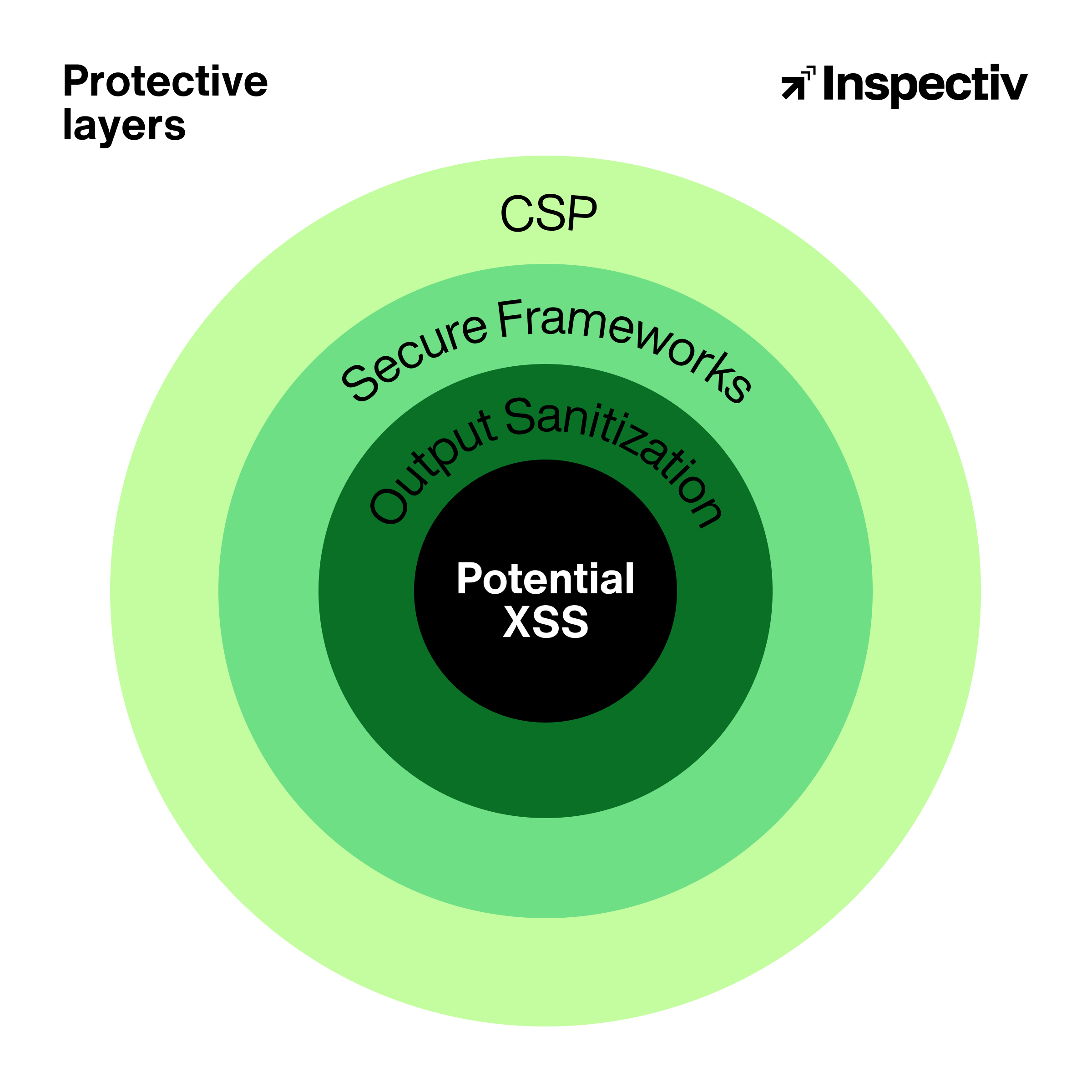
XSS may be one of the oldest web vulnerabilities, but it remains one of the most impactful. By adopting modern frameworks, enforcing proper output encoding, and using browser-level protections like CSP, organizations can significantly reduce their exposure.
For platforms that thrive on user-generated content, taking these precautions is not optional, it’s essential to protecting both your users and your business.Ready to strengthen your security posture and eliminate blind spots? Schedule a demo with Inspectiv to learn more.
Ready to level up your AppSec program? Book a personalized demo to see how Inspectiv helps you uncover real risks, streamline workflows, and scale your security program through one unified platform designed to operate the way your team does.












.svg?width=32&height=32&name=icon%20(1).svg)
.svg?width=32&height=32&name=icon%20(2).svg)
.svg?width=32&height=32&name=icon%20(3).svg)