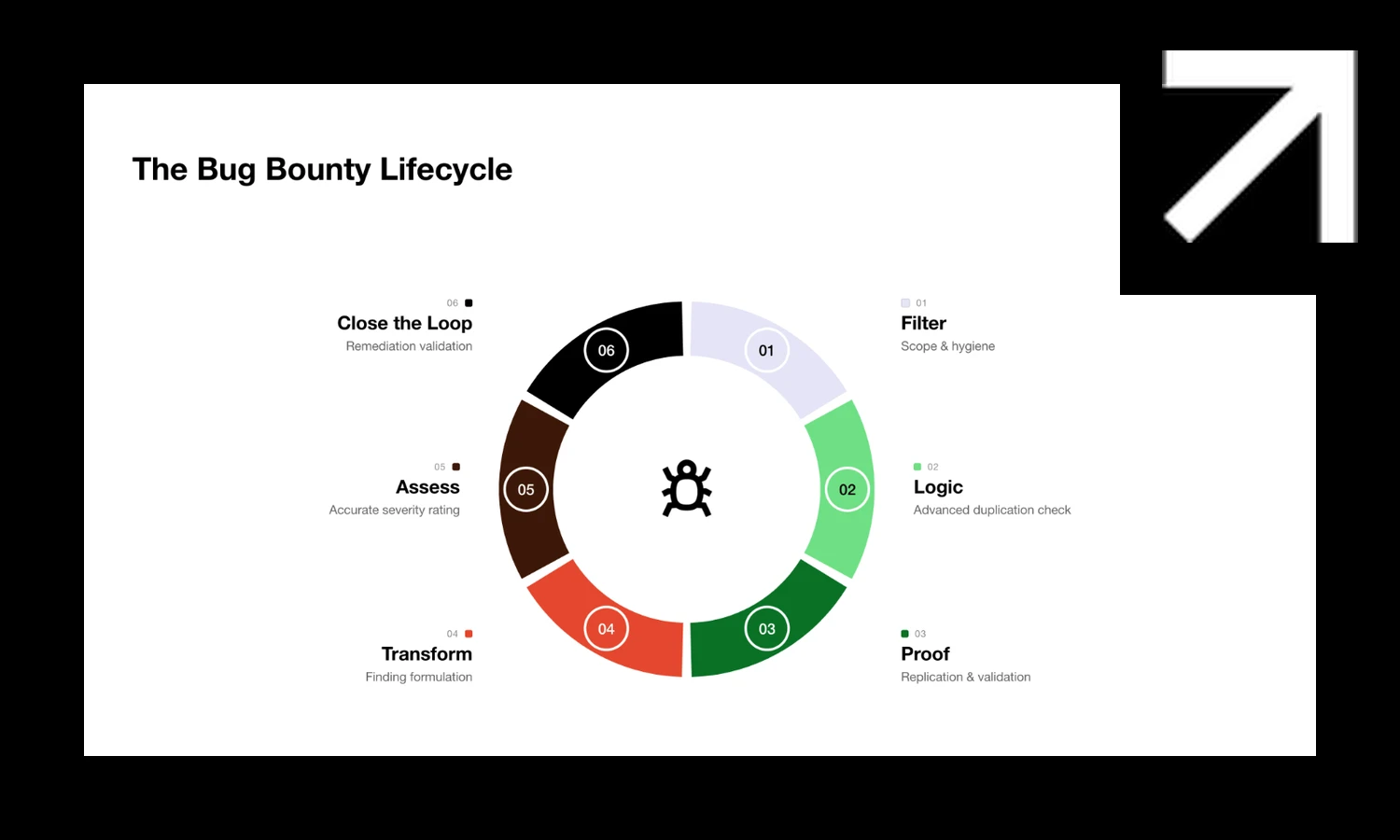
How Researchers Are Using AI to Find Vulnerabilities, and What It Means for Your Program
AI has moved from a novelty to a default part of the bug bounty researcher's toolkit. Security research tool adoption, data and community benchmarks consistently show the majority of active researchers now incorporate AI at multiple stages of the hunting lifecycle, most commonly for recon automation, scanner noise triage, and report drafting, freeing time for the creative work of chaining vulnerabilities.
The most visible development of the past 12 months is the rise of fully autonomous testing agents. These are AI systems capable of conducting reconnaissance, identifying targets, generating exploit code, and submitting findings with minimal human input. AppSec Santa's 2026 benchmark of 39+ AI pentesting tools found autonomous agents now operating across every major vulnerability class, with some approaching the coverage rates of experienced human researchers on structured benchmarks.
It’s important for program managers to understand how human and automated researchers are using AI today, the technology stack behind it, and the emerging risks to plan for. The biggest risk isn't that AI will replace your researchers. It's that AI will flood your program with low-quality submissions that overwhelm your triage capacity before you've reviewed the legitimate findings.
How AI Fits Into the Hunting Workflow
Across both individual researchers and automated frameworks, AI is applied at four stages of the hunting lifecycle:
-
Reconnaissance: Traditional tools (Subfinder, Amass, httpx, Naabu, Nuclei) enumerate the attack surface. An LLM then summarizes and prioritizes the raw output, turning hundreds of lines of scan results into a ranked list of interesting assets in minutes rather than hours.
-
Analysis & triage: LLMs review code, flag likely vulnerability classes from technology fingerprints, cross-reference CVE databases, and cut through scanner false positives (the single most common use case reported by researchers).
-
Exploitation: More advanced setups generate exploit code or select Metasploit modules for prioritized findings, and in fully agentic frameworks, chain multiple weaknesses together autonomously.
-
Reporting: AI drafts the vulnerability writeup with impact, reproduction steps, and remediation guidance which a human researcher (or, increasingly, an automated review step paired with a human reviewer) checks before submission.
Industry framing is consistently “augmentation, not replacement” for most researchers: AI handles the repetitive, high-volume work so humans can focus on contextual reasoning and creative vulnerability chaining.
The Technology Stack
Tooling varies by researcher, but a consistent pattern has emerged across public frameworks (e.g., open community projects like “claude-bug-bounty” and “bughunter-ai”):
| CATEGORY |
REPRESENTATIVE TOOLS & TECHNOLOGIES |
ROLE IN THE WORKFLOW |
| Foundation Models |
Claude (Opus for deep analysis, Sonnet for speed), GPT-5-class models, Gemini |
Reasoning over recon output, code review, exploit-chain hypothesis generation, report drafting |
| Recon & Asset Discovery |
Subfinder, Amass, httpx, Naabu, Masscan, Katana |
Enumerate subdomains, live hosts, open ports and crawl attack surface at scale |
| Scanning & Fuzzing |
Nuclei, FFuf, Arjun |
Match known CVE/misconfig templates, parameter and endpoint fuzzing |
| Orchestration / Agent Frameworks |
Claude Code + MCP, LangChain-style agent loops, custom “coordinator + solver” architectures |
Chain recon → hypothesis → exploit → validation steps with minimal human input |
| Knowledge Representation |
Neo4j / graph databases, RAG over exploit-DB and CVE corpora |
Turn raw scan output into a queryable attack-surface model the LLM can reason over |
| Manual-Testing Copilots |
Burp AI (Repeater Explainer, Explore Issue, AI-generated logins), Burp MCP Server extension |
Human-in-the-loop assistance inside the researcher's existing toolchain |
| AI/LLM-Specific Red-Teaming |
Burp AI, PyRIT, Giskard, promptfoo |
Probe target AI features for prompt injection, jailbreaks and data leakage (OWASP-LLM, MITRE ATLAS) |
| Reporting |
LLM-drafted writeups with human review |
Convert findings and PoCs into client-ready vulnerability reports |
Emerging Risk: Report Quality and “AI Slop”
The same accessibility that lets skilled researchers move faster also lowers the bar for low-effort, AI-generated submissions that don’t include true vulnerabilities or negative security impact. Reported effects across the industry in 2026 include:
In response, OpenAI launched a dedicated AI-safety bug bounty in late March 2026, focused specifically on prompt injection, agent data exfiltration, and harmful autonomous actions, signaling that AI-native vulnerability classes are becoming a distinct scope category in their own right.
What This Means for your Program
-
Expect higher submission volume with a lower average signal-to-noise ratio. Triage capacity (human or automated) is now a bigger bottleneck than researcher supply.
-
Consider whether your scope and disclosure policy address automated/agentic submissions explicitly, including whether tools with fully autonomous agents are permitted and how they must be disclosed.
-
AI-native attack surface (any LLM or agent features in your product) is a fast-growing, distinct testing category worth scoping in separately, mapped to OWASP-LLM and MITRE ATLAS. Include prompt injection, data exfiltration via agents, and jailbreaks.
-
On the defense side, the same AI copilot tools (Burp AI, MCP-based integrations) are lowering the cost of thorough manual testing, which is a net positive for legitimate researchers working your program.
How Inspectiv Solves This
The AI slop problem is real, and it’s getting worse. At Inspectiv, we’ve built our platform specifically so it’s our problem to solve, not yours.
You only receive validated, human-verified findings with clear reproduction steps and remediation guidance.
At the same time, we lean into what AI does well. Our researchers use AI to move faster on recon, triage scanner noise, and identify complex attack chains that would take far longer manually. Our expert triage ensures only what’s real and relevant makes it to you.
The result: signal over noise.
If you want to know what’s actually exploitable in your environment, let's talk.
Sources & Additional Resources












.svg?width=32&height=32&name=icon%20(1).svg)
.svg?width=32&height=32&name=icon%20(2).svg)
.svg?width=32&height=32&name=icon%20(3).svg)