Platform
Explore Inspectiv’s AI-enabled platform that integrates Bug Bounty, Pentesting, Feature Testing, and VDP, designed to cut through noise and deliver signal-driven results.

Platform
Explore Inspectiv’s AI-enabled platform that integrates Bug Bounty, Pentesting, Feature Testing, and VDP, designed to cut through noise and deliver signal-driven results.

Bug Bounty
Continuously discover high-impact vulnerabilities, without the overhead of traditional bug bounty programs.

Penetration Testing
Stay audit-ready and reduce risk with expert-led testing and flexible retesting support.
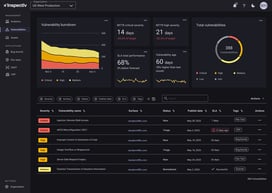
See Inspectiv in Action!
Schedule a live demo to see how our platform helps you manage vulnerabilities, reduce noise, and stay compliant.
See Inspectiv in Action!
Schedule a live demo to see how our platform helps you manage vulnerabilities, reduce noise, and stay compliant.

Inspectiv Insights
July 7, 2026
Recent Inspectiv findings, and what do to about them.
Read the latest insights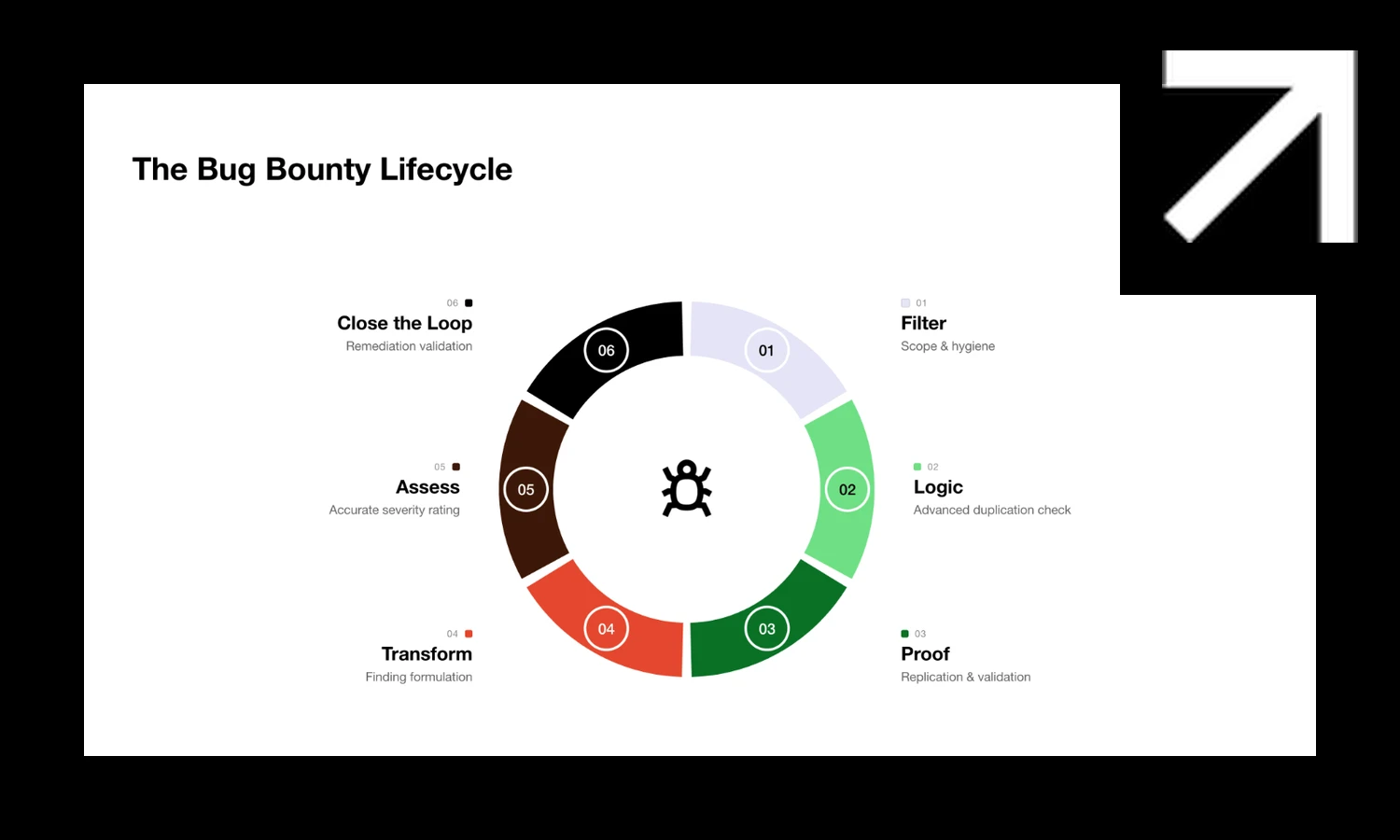
In the fast-paced world of cybersecurity, discovering a vulnerability is only half the battle. For organizations leveraging the power of the crowd through bug bounty programs, the real challenge lies in distinguishing valid, high-risk signals from the noise of invalid reports. A bug bounty submission isn't just a ticket; it is the beginning of a rigorous lifecycle designed to protect an organization's time, budget, and infrastructure.
But what actually happens between the moment a researcher clicks "submit" and the moment a security team receives a polished vulnerability report?
While the journey may vary by program, a lifecycle process that employs best practices involves a sophisticated blend of automated logic and human expertise. Through triage, replication, and validation, raw submissions get transformed into high-value findings.
Here is an inside look at how that lifecycle operates and why each step ensures stronger security outcomes for your organization.
The lifecycle begins when a security researcher submits a report through the program’s intake platform. Immediate intake protocols activate to ensure the submission adheres to the program’s specific rules. This initial phase is crucial for noise reduction.
Triage analysts first verify if the reported asset is in scope since security programs often have strict boundaries to protect critical operations. For example, specific testing types, such as social engineering (phishing), physical security attacks, or Denial of Service (DoS), are frequently classified as "out of scope" to prevent operational disruption. A submission targeting an excluded asset or utilizing a forbidden methodology is rejected immediately. This ensures that your internal security team is never distracted by reports that violate your rules of engagement.
Once a report passes the scope check, it faces one of the most complex challenges in bug bounty management: de-duplication.
In a hard-working research environment, multiple ethical hackers often discover the same vulnerability. An organization should never have to pay for the same information twice, nor should their engineering team waste cycles assigning tickets to fix a bug that is already in the remediation pipeline.
Meticulous triage compares new submissions against every historical report previously filed for that program. This isn't just a surface-level check, but a comparison of vulnerability type, endpoint, and parameters involved. If a researcher reports a Cross-Site Scripting (XSS) flaw that was reported two months ago and is currently being fixed, the new submission is marked as a duplicate and rejected. This check ensures financial fairness for the client and operational efficiency for the engineering team.
This step matters even more as AI tooling drives up submission volume industry-wide. Some programs have suspended or restructured their intake specifically because of a flood of AI-generated, low-signal reports. Rigorous de-duplication and scope enforcement are important steps in sorting through that volume to pinpoint what actually needs attention.
If a submission is unique and in-scope, it moves to the validation phase. This is where analysts put on their "hacker hats" to verify the claim.
A report is only as good as its reproducibility. Reputable programs do not simply trust the text of a report; they require proof. Researchers provide a proof-of-concept, often in the form of video evidence or specific exploit code, demonstrating the vulnerability in action.
Analysts independent from the researcher who submitted the report attempt to replicate the exploit exactly as described. If the steps are vague or the exploit fails to execute, the process is paused for further clarification. If the issue cannot be reproduced, it does not become a finding. This step is the ultimate firewall against false positives, ensuring that when your team receives a report, it is a verified, real-world risk.
Once validated, a raw submission undergoes a significant transformation to become a client-facing "finding". Raw reports from researchers can vary wildly in quality. Some are excellent, while others may be disorganized or filled with technical jargon. Mature programs rewrite and reformat the report to ensure professional consistency, a process that typically includes:
Third-Person Objectivity: Stripping away first-person narratives (e.g., "I hacked this") and standardizing the language to be objective and professional.
Technical Clarity: Formatting payloads and HTTP requests into clean code blocks rather than inline text, ensuring your developers can copy and paste the data for their own testing without formatting errors.
Impact Analysis: ensuring the steps to reproduce conclude with a clear statement of negative impact, explaining exactly what an attacker can achieve, such as automating malicious actions within a victim's session.
This polishing phase turns a rough bug report into a clear, actionable instruction manual for remediation.
Before the report reaches a security team, it needs an accurate rating. Misclassified severity leads to misallocated resources: panic over low-risk bugs or complacency toward critical ones.
A sound methodology calculates risk objectively, determining a base severity (e.g., SQL Injection is typically Critical) and then adjusting based on context. Two key factors drive this adjustment:
1. Impact: the demonstrated negative impact. Can data be stolen? Can systems be compromised?
2. Required Privileges: the barrier to entry. A vulnerability that anyone can exploit is rated higher than one requiring an Administrator account to trigger.
This calculated approach is what lets a security team prioritize the fires that actually need putting out.
The lifecycle doesn't end when the report is published. After your team fixes the vulnerability, remediation validation provides critical final assurance that the finding is resolved.
Analysts retrace the original steps to ensure the fix is effective, attempting to break it again. If the exploit still works, they provide feedback on why the patch failed. Only when the vulnerability is confirmed to be neutralized does the loop close.
Each phase above reflects a best practice. Whether a program runs in-house or through a vendor, these are the questions that reveal whether it's actually working:
Managed well, from the initial filter of intake to the final check of remediation, this lifecycle is what separates a bug bounty program that delivers signal from one that floods a security team with noise. The discipline of scope enforcement, de-duplication, independent validation, clear formatting, accurate severity, and remediation verification is what turns a bug bounty program from a compliance checkbox into an ongoing security assurance capability, the kind of evidence CISOs increasingly need for Zero Trust initiatives and board-level reporting.
Inspectiv runs this exact lifecycle for its bug bounty customers. Every submission is checked against scope and prior reports, validated by analysts, reformatted into a clear finding, and rated using Inspectiv's own severity framework (ISRM), which weighs impact and required privileges rather than relying on a single CVSS number. After a fix ships, Inspectiv retests the original exploit to confirm it's actually closed. By absorbing the noise, verifying the risks, and delivering actionable intelligence, your internal team can focus on what they do best: building and security your product.
If you want to see this lifecycle in practice, let’s talk.
Ready to level up your AppSec program? Book a personalized demo to see how Inspectiv helps you uncover real risks, streamline workflows, and scale your security program through one unified platform designed to operate the way your team does.







.svg?width=32&height=32&name=icon%20(1).svg)
.svg?width=32&height=32&name=icon%20(2).svg)
.svg?width=32&height=32&name=icon%20(3).svg)