Platform
Explore Inspectiv’s AI-enabled platform that integrates Bug Bounty, Pentesting, Feature Testing, and VDP, designed to cut through noise and deliver signal-driven results.


Ethical hacking and penetration testing share similarities, but they serve different purposes. Ethical hacking is broad, continuous, and designed to identify weaknesses across an entire information system, sometimes spanning cloud, identity, social engineering, and web application layers. Penetration testing is structured, scoped, and time-bound, built to answer a specific question: How vulnerable is this asset right now?
Security leaders rely on both. Ethical hacking supports strategic risk reduction, while pen testing delivers point-in-time assurance and governance. A modern platform blends the strengths of each by automating repetitive tasks and giving teams a clearer view of security vulnerabilities across networks or applications.
Security teams often combine pentesting as a service with bug bounty programs, blending methodical validation with researcher-driven insights across evolving attack surfaces.
Ethical hacking vs penetration testing is a common comparison, but the terms aren’t interchangeable. Both involve authorized attempts to uncover security vulnerabilities before malicious actors exploit them. Both involve skilled practitioners whether a certified ethical hacker (CEH) or an experienced penetration tester. And both help organizations understand how an attacker might target computer systems, sensitive information, or other high-value assets.
But the intent, scope, and outcomes differ.
Understanding these distinctions helps teams decide which method supports their immediate objectives and whether broad vulnerability assessment, governance requirements, or deep validation of specific controls.
Ethical hacking acts like an ongoing research program designed to represent how attackers think, behave, and chain weaknesses together. Ethical hackers are not limited to a single specific area; they explore wherever risk exists.
Common coverage areas include:
Ethical hacking is exploratory and continuous. It adapts as a business evolves, as new assets appear, and as attack surfaces shift. This makes ethical hacking a strong fit for organizations that want real-world validation beyond scheduled assessments.
See how researcher-driven discovery works in practice, and how modern programs evolve over time.
Penetration testing and ethical hacking often appear similar from the outside, but pen testing is far more structured. It is a scoped engagement that assesses the security posture of a defined asset, such as a web application, API, internal environment, or mobile app.
Pen testing is designed to:
It answers a simple question: “How vulnerable is this system right now?”.
This makes pen testing essential for board-level reporting, compliance audits, vendor assessments, and regulatory attestations, all areas where ethical hacking may be too broad or unbounded.
Organizations that need structured validation often rely on Pentesting as a Service to get deeper assurance and reduce overhead.
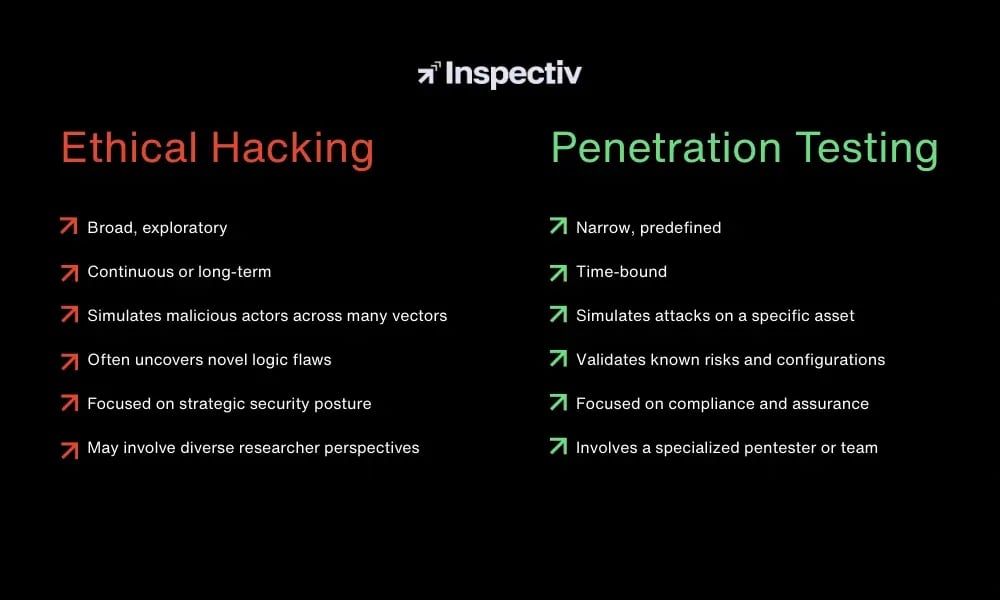
This is why many organizations use both, depending on the decision they’re trying to support:
strategic risk reduction (ethical hacking) vs. assurance and governance (penetration testing).
Reports highlight patterns, systemic weaknesses, emerging attack paths, and how an attacker could pivot through an environment. These insights often help guide strategic investments and align security with business operations.
Reports focus on detailed findings: evidence, reproduction steps, severity, and remediation guidance. They are formatted to support compliance needs and governance activities.
Organizations commonly pair both reporting styles to get a full view: strategic visibility + tactical impact.
Ethical hacking and penetration testing differ in scope because ethical hacking looks broadly across many systems, vectors, and attack paths, while penetration testing focuses on a specific, predefined asset. Ethical hacking explores wherever risk may exist, whereas a pen test concentrates on validating a single target within a controlled boundary.
Technically, yes. Penetration testing is one category within the broader ethical hacking discipline. However, treating them as equivalents oversimplifies the intent behind each.
Ethical hacking includes red teaming, adversarial simulations, discovery across unknown environments, and sometimes even physical vector analysis. Pen testing, meanwhile, is scoped and methodical.
Both require authorization, controlled execution, and a commitment to avoid harming production systems.
Ethical hacking is more proactive because it continuously adapts to new risks. It mirrors how malicious actors behave: creatively, unexpectedly, and across system boundaries.
Pen testing is more structured: a snapshot that helps teams confirm whether security measures are functioning as intended at a point in time.
The most mature organizations unify both approaches through a platform that supports:
This is the model behind the Inspectiv Platform which centralizes findings and reduces noise.
Both ethical hacking and penetration testing require authorization because each involves intentional attempts to exploit weaknesses in systems. Without formal approval, the activity could be unsafe, disruptive, or considered unlawful.
An organization should choose penetration testing when it needs a structured, scoped evaluation of a specific asset, often tied to compliance, a vendor requirement, or a need for formal evidence and reporting. Pen tests are best for validating the current security posture of a well-defined target.
Ethical hackers and pentesters often use similar tools: recon, exploitation frameworks, OSINT, payload generation, fuzzing, but with different objectives.
Both are essential for a robust, layered security program.
Absolutely. And they should. A strong security strategy blends:
Combining these approaches helps organizations identify vulnerabilities earlier, respond faster, and strengthen long-term posture.
Ethical hacking is more appropriate than pentesting when an organization needs broad, continuous discovery across many systems, or when it wants to understand how a malicious actor could chain weaknesses together. Ethical hacking fits dynamic environments where risk evolves quickly.
The goals of ethical hacking and penetration testing differ because ethical hacking aims to uncover any weakness an attacker could exploit across an entire environment, while penetration testing aims to evaluate the security of one defined asset and provide actionable remediation guidance.
Ethical hacking is often better for discovering logic flaws or complex issues because it is unrestricted in where it can investigate and how it can pivot. Pen tests can find these issues as well, but only within the boundaries of the defined assessment.
If you want to understand how Inspectiv blends structured penetration testing, continuous ethical hacking, and intelligent automation into one unified platform, request a demo and see how teams get clearer, faster, more actionable security insights.
Ready to level up your AppSec program? Book a personalized demo to see how Inspectiv helps you uncover real risks, streamline workflows, and scale your security program through one unified platform designed to operate the way your team does.












.svg?width=32&height=32&name=icon%20(1).svg)
.svg?width=32&height=32&name=icon%20(2).svg)
.svg?width=32&height=32&name=icon%20(3).svg)