Platform
Explore Inspectiv’s AI-enabled platform that integrates Bug Bounty, Pentesting, Feature Testing, and VDP, designed to cut through noise and deliver signal-driven results.

Platform
Explore Inspectiv’s AI-enabled platform that integrates Bug Bounty, Pentesting, Feature Testing, and VDP, designed to cut through noise and deliver signal-driven results.

Bug Bounty
Continuously discover high-impact vulnerabilities, without the overhead of traditional bug bounty programs.

Penetration Testing
Stay audit-ready and reduce risk with expert-led testing and flexible retesting support.
See Inspectiv in Action!
Schedule a live demo to see how our platform helps you manage vulnerabilities, reduce noise, and stay compliant.
See Inspectiv in Action!
Schedule a live demo to see how our platform helps you manage vulnerabilities, reduce noise, and stay compliant.

Inspectiv Insights
July 7, 2026
Recent Inspectiv findings, and what do to about them.
Read the latest insights
Bug bounty programs have become a proven way to uncover real-world vulnerabilities before attackers do. They bring fresh eyes, diverse expertise, and continuous testing that goes beyond what automated scanners or point-in-time penetration tests can catch.
But while bug bounty is often discussed as a “must-have” security practice, the reality is this: Standing up a successful bug bounty program is difficult for small to mid-sized businesses (SMBs), especially those without a dedicated vulnerability operations team.
If you’re an AppSec leader or security engineer at a growing software company, you’ve likely considered bug bounty and asked questions like:
Those concerns are valid, particularly with the rise in volume of AI-generated findings, and they’re why many organizations either delay bug bounty entirely or launch a program that becomes painful to manage.
The stakes for SMBs are real: the Verizon 2025 Data Breach Investigations Report states that ransomware now appears in 88% of confirmed SMB data breaches — more than double the rate at large enterprises.
Bug bounty is often pitched as “crowdsourced security.” But for smaller teams, it can quickly feel like crowdsourced chaos.
Here are the four most common barriers:
The #1 hidden cost of bug bounty isn’t payout spend. It’s internal time.
Once a program goes live, submissions start coming in. Some will be excellent. Many won’t.
Your team has to:
For teams juggling sprint work, security reviews, compliance requirements, and incident response readiness, bug bounty triage becomes an additional full-time job.
And if triage isn’t done well? Researchers get frustrated, reports pile up, and the program loses credibility fast.
The fix: managed triage
Managed bug bounty with dedicated expert triage solves this. Your team only sees validated, high-signal vulnerabilities, not noise, spam, or endless duplicates. That means fewer distractions and faster time to fix.
A substantial share of bug bounty reports are invalid, duplicative, or speculative. Without skilled triage, even a well-scoped program will quickly bury an internal team. Good triage isn’t just filtering, it’s evaluating each report across multiple dimensions:
That multi-factor assessment is what separates an actionable vulnerability report from a raw CVSS score.
Forward-looking tools like the Exploit Prediction Scoring System (EPSS) add another layer, dynamically raising or lowering a vulnerability’s urgency based on active exploitation activity in the wild. The best triage processes incorporate this kind of real-world context rather than relying on static severity scores alone.
Traditional bug bounty models are variable by design. If your product has a big release, a new API, or a newly exposed surface area, submission volume can spike.
That makes it hard to answer basic budgeting questions like:
For many SMB and mid-market orgs, unpredictable spend becomes a blocker, especially when security budgets are scrutinized quarterly.
Why this matters: according to IBM's 2025 Cost of a Data Breach Report, the average cost of a data breach in the U.S. hit an all-time high of $10.22M. The prior year’s report found that for organizations with fewer than 500 employees, that number sits at $3.31M. A well-structured bug bounty program costs a fraction of that if the pricing model is one you can actually plan around.
The fix: Fixed-cost bug bounty
Fixed-cost and subscription bug bounty models exist specifically for teams that need cost control. With predictable pricing, you can run a program without financial uncertainty and make a defensible business case for the investment, while still getting the breadth of crowdsourced security testing.
The contrast between pay-per-bug and fixed-cost models is worth understanding. Pay-per-bug rewards volume: researchers get paid for every accepted submission, which can incentivize lower-quality reports and pressure teams to accept borderline findings. Flat-fee or subscription models flip that dynamic. The emphasis shifts to validated, prioritized, high-value results rather than raw submission count.
Pairing a fixed-cost model with clear remediation SLAs also makes it easier to plan engineering capacity. For guidance, here are Inspectiv’s default recommended expectations for remediation SLAs:
That structure lets teams plan sprint work around security rather than reacting to unpredictable surges.
Launching bug bounty isn’t as simple as saying “test our app.”
A good program requires:
If scope is too narrow, you won’t get meaningful results. If scope is too broad, you may invite testing on areas your team can’t support and create unnecessary risk.
The fix: Get the scope right (without the guesswork)
To right-size your scope, start by identifying your actual risk priorities and team capacity, and map your scope accordingly. In the beginning, go narrower than you think you need to: a focused program with quality findings beats broad scope with noise every time. You can always expand once the program is running smoothly.
It also helps to understand the lifecycle patterns bug bounty programs typically follow. When you’re managing your own program, early on you should expect a surge of surface-level findings. As researchers get familiar with the attack surface, they go deeper. A tighter initial scope helps manage that ramp-up without exposing systems your team isn’t ready to triage or remediate against.
Scope decisions also govern timing. Submission volume reliably spikes whenever there’s a major feature release, infrastructure migration, acquisition, or any other new attack surface appears. A well-scoped program gives you control over when and where researcher attention lands, rather than having it hit everything at once.
Bug bounty programs work best when they’re integrated into the development lifecycle:
That’s a mature vulnerability operations workflow. Most smaller security teams don’t have the bandwidth to build it from scratch.
Security staffing shortages make this harder to solve internally: 55% of security teams are understaffed and 65% have unfilled security roles, according to ISACA. The bandwidth to architect a custom vulnerability operations workflow from scratch often simply doesn’t exist.
The fix: A more realistic operational model
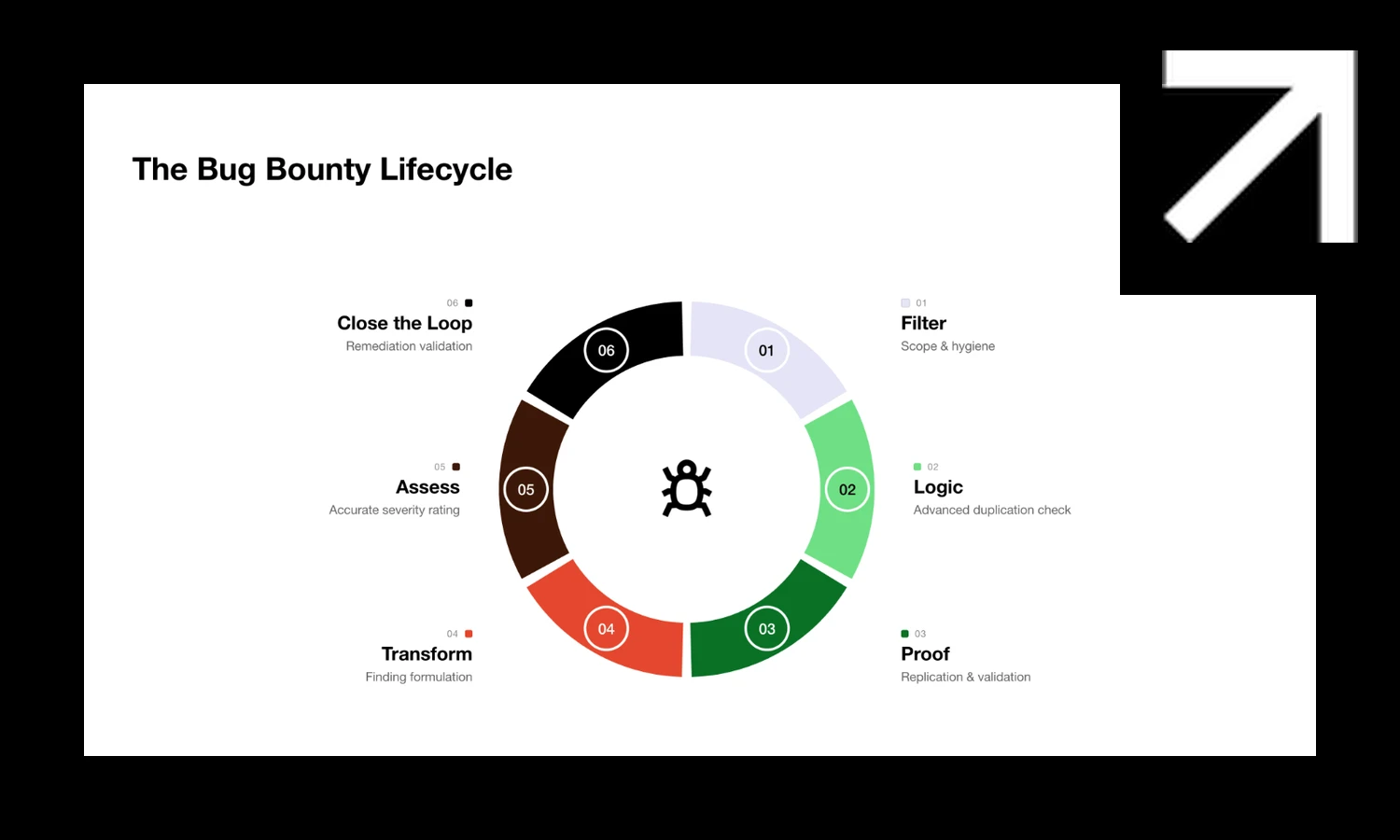
A platform plus managed service model makes bug bounty operationally realistic for smaller teams. What that looks like:
In practice, that means every submission is validated and retested before it reaches your engineers, filtering out false positives and duplications. Findings flow directly into the tools your engineering team already uses, like Slack, Jira, and CI/CD pipelines. Each finding arrives with clear context: reproduction steps, severity reasoning, and remediation guidance. Researcher communication, retesting, and validation happen externally, so your team focuses on fixing issues, not managing process.
What comes through is actionable signal. For lean teams that can’t afford a critical finding to sit unread over a weekend, that’s the operational model that actually works.
For SMB and mid-market software companies, bug bounty can be one of the highest ROI security investments, but only if it’s a sustainable program.
The most successful programs aren’t the ones that generate the most reports. They’re the ones that generate the most actionable, validated, prioritized security findings without derailing the team.
That’s the difference between “running a bug bounty” and actually benefiting from one.
Inspectiv helps organizations launch and scale bug bounty programs without:
If you’re a growing security team that wants the power of bug bounty, with the structure, predictability, and support to make it work, let’s talk.
Ready to level up your AppSec program? Book a personalized demo to see how Inspectiv helps you uncover real risks, streamline workflows, and scale your security program through one unified platform designed to operate the way your team does.








.svg?width=32&height=32&name=icon%20(1).svg)
.svg?width=32&height=32&name=icon%20(2).svg)
.svg?width=32&height=32&name=icon%20(3).svg)