Platform
Explore Inspectiv’s AI-enabled platform that integrates Bug Bounty, Pentesting, Feature Testing, and VDP, designed to cut through noise and deliver signal-driven results.


Most security teams don’t fail at finding vulnerabilities, they fail at fixing them efficiently. Between triage bottlenecks, tool sprawl, and limited validation, organizations spend millions trying to close the remediation gap. This article explores why vulnerability remediation challenges persist, how continuous validation helps, and what Inspectiv’s customers are doing differently to turn findings into verified fixes.
Even the most mature security programs struggle to turn vulnerability data into measurable outcomes. The issue isn’t a lack of findings, it’s remediation friction.
Common vulnerability remediation challenges include:
The result? Security debt.
According to the IBM Cost of a Data Breach 2025 report, unremediated vulnerabilities contribute to average losses of $4.24 million per breach and fixing vulnerabilities post-deployment can be 10–30 times costlier than addressing them earlier in the SDLC.
Read next: Why Validation Matters in Security Testing
Delays in addressing vulnerabilities don’t just increase breach risk, they drain operational budgets and disrupt developer productivity.
Organizations spend an estimated $1.4 million annually on vulnerability management activities such as patching, monitoring, and documentation. But only a fraction of that spend translates into actual risk reduction.
Here’s why:
When remediation takes too long, attackers gain the advantage. Publicly disclosed vulnerabilities (CVEs) are often weaponized in hours. Worse, they can breakout and achieve lateral movement in minutes or seconds, faster than any human response.
Addressing vulnerabilities effectively requires a shift from volume-based scanning to validation-based remediation. That’s where continuous threat exposure management (CTEM) platforms redefine the remediation process.
Here’s how high-performing teams approach the cycle:
This feedback loop not only improves security posture but also strengthens compliance alignment with frameworks like NIST CSF, ISO 27001, and SOC 2.
While not every challenge can be automated away, many can be mitigated with process discipline and better coordination between AppSec and DevOps.
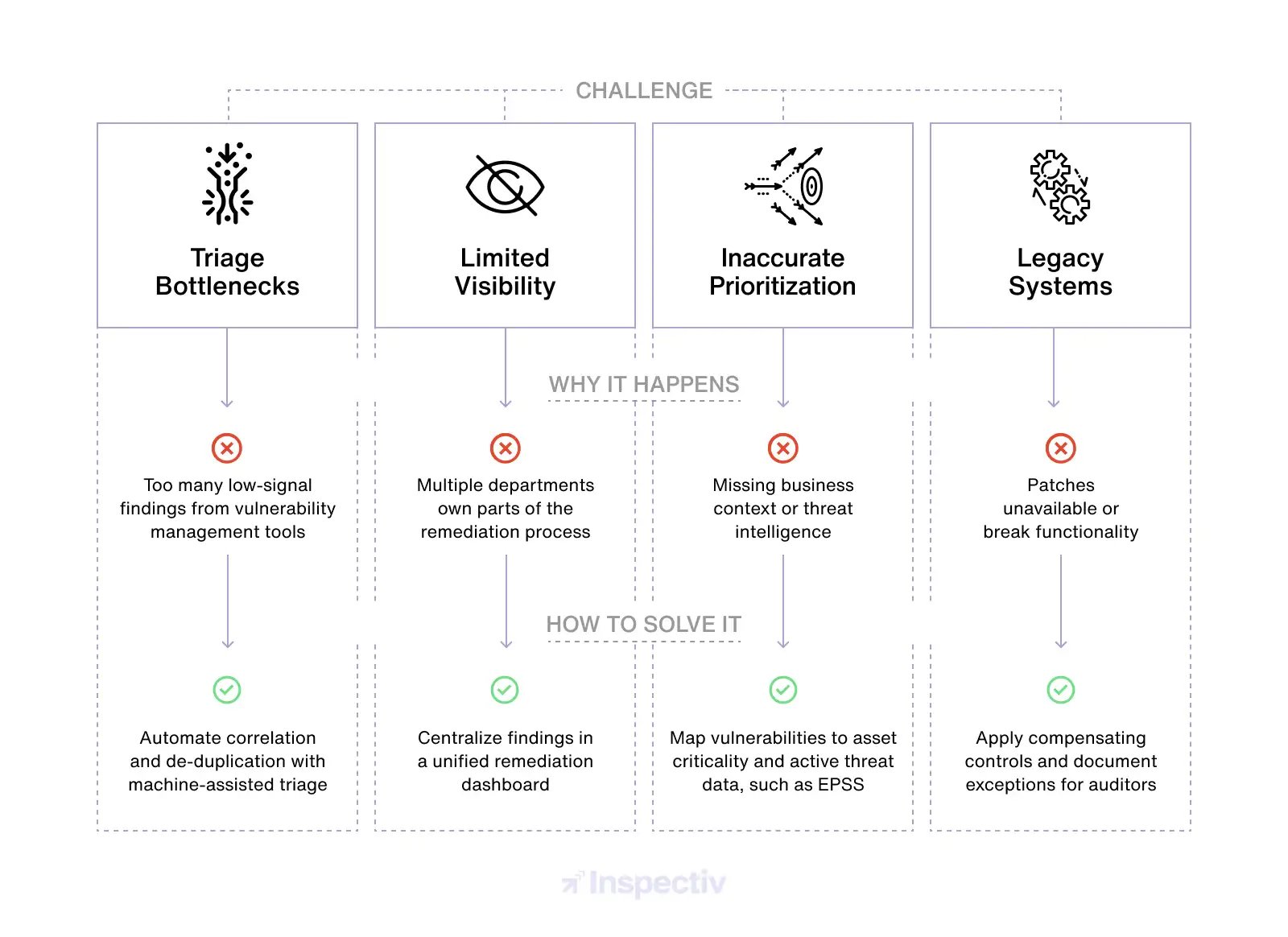
This structured approach turns remediation from a backlog into a continuous improvement process that supports both risk reduction and operational efficiency.
Continuous validation isn’t about automating everything, it’s about combining human expertise with automated insights to ensure every fix counts.
Unlike simple vulnerability scanning, continuous validation involves retesting fixes, correlating results, and feeding outcomes back into the remediation workflow. This prevents regression, reduces false positives, and accelerates overall security maturity.
Inspectiv’s approach blends automation with expert triage by helping teams move beyond “patching fast” to remediating intelligently. Through Bug Bounty and Vulnerability Disclosure Program, organizations gain access to ethical hackers who validate vulnerabilities in real-world conditions, providing actionable, verified results.
To overcome recurring challenges in vulnerability remediation, leaders should focus on integrating three core pillars into their vulnerability management strategy:
By combining continuous testing, guided validation, and centralized reporting, Inspectiv helps teams address vulnerabilities with precision by transforming remediation from a reactive task into a proactive security capability.
Learn How to Prioritize and Fix the Right Issues.
Rapid cloud changes, unclear ownership across shared responsibility models, excessive false positives, and limited real-time validation make it difficult to verify fixes and maintain secure configurations.
Constant code changes, complex environments, and unclear ownership slow remediation. Limited validation and false positives make it hard to confirm issues are truly resolved and stay fixed.
The process includes discovery, prioritization, remediation, and retesting. Teams first identify vulnerabilities through testing or scanning, then rank them by risk. Engineering applies fixes, while retesting confirms each issue is resolved and remains secure through continuous testing.
Discovery surfaces weaknesses, prioritization focuses on the highest-impact risks, remediation applies verified fixes, and validation ensures those fixes hold up over time. Together, these steps create a continuous feedback loop between Security, IT, and engineering for faster, more reliable security outcomes.
When a fix isn’t possible right away, teams should apply temporary mitigations like access controls or configuration changes, increase monitoring, and document risk acceptance until remediation or validation testing confirms resolution. These are sometimes called compensating controls and are acceptable under many compliance requirements, such as PCI-DSS.
Vulnerability remediation challenges aren’t going away but how you address them determines your security maturity.
Organizations that connect vulnerability discovery with better remediation not only fix faster but they build trust, reduce security debt, and prove impact with every verified fix.
Ready to level up your AppSec program? Book a personalized demo to see how Inspectiv helps you uncover real risks, streamline workflows, and scale your security program through one unified platform designed to operate the way your team does.










.svg?width=32&height=32&name=icon%20(1).svg)
.svg?width=32&height=32&name=icon%20(2).svg)
.svg?width=32&height=32&name=icon%20(3).svg)