Platform
Explore Inspectiv’s AI-enabled platform that integrates Bug Bounty, Pentesting, Feature Testing, and VDP, designed to cut through noise and deliver signal-driven results.


Scoping is not the hardest part of security testing—but it is the part where small mistakes quietly turn into big problems.
First, let’s define scoping. It’s the process by which it is abundantly clear what is to be tested. This is typically a list of URLs, IP addresses (including CIDR) and API endpoints. So to test a web application, it must be defined in those more precise terms.
In modern security programs, especially those running penetration tests or bug bounty programs, scoping failures rarely look dramatic at first. They show up later as missed assets that weren’t tested, noisy findings, unexpected traffic, or worse: attacker-like traffic (which all security testing is) on unintended targets that triggers alarms.
At Inspectiv, we see the same pattern repeatedly. Organizations are motivated to test, but gaps in asset knowledge, fast-moving environments, and unclear ownership make precise scoping harder than it should be. The result is not bad intent or lack of maturity—it’s friction between how environments actually work and how scope is traditionally defined.
The good news: scoping does not need to be heavyweight, fragile, or vendor-driven. With the right structure, customer-controlled scoping becomes more accurate, safer, and ultimately produces better testing outcomes.
Most security teams understand their core systems well. The problems tend to appear at the edges:
A common example we encounter is API uncertainty. When asked how many APIs are associated with a given web application, teams often cannot answer confidently. That is not negligence—it reflects how modern development works. APIs proliferate behind feature flags, internal services, and third-party integrations.
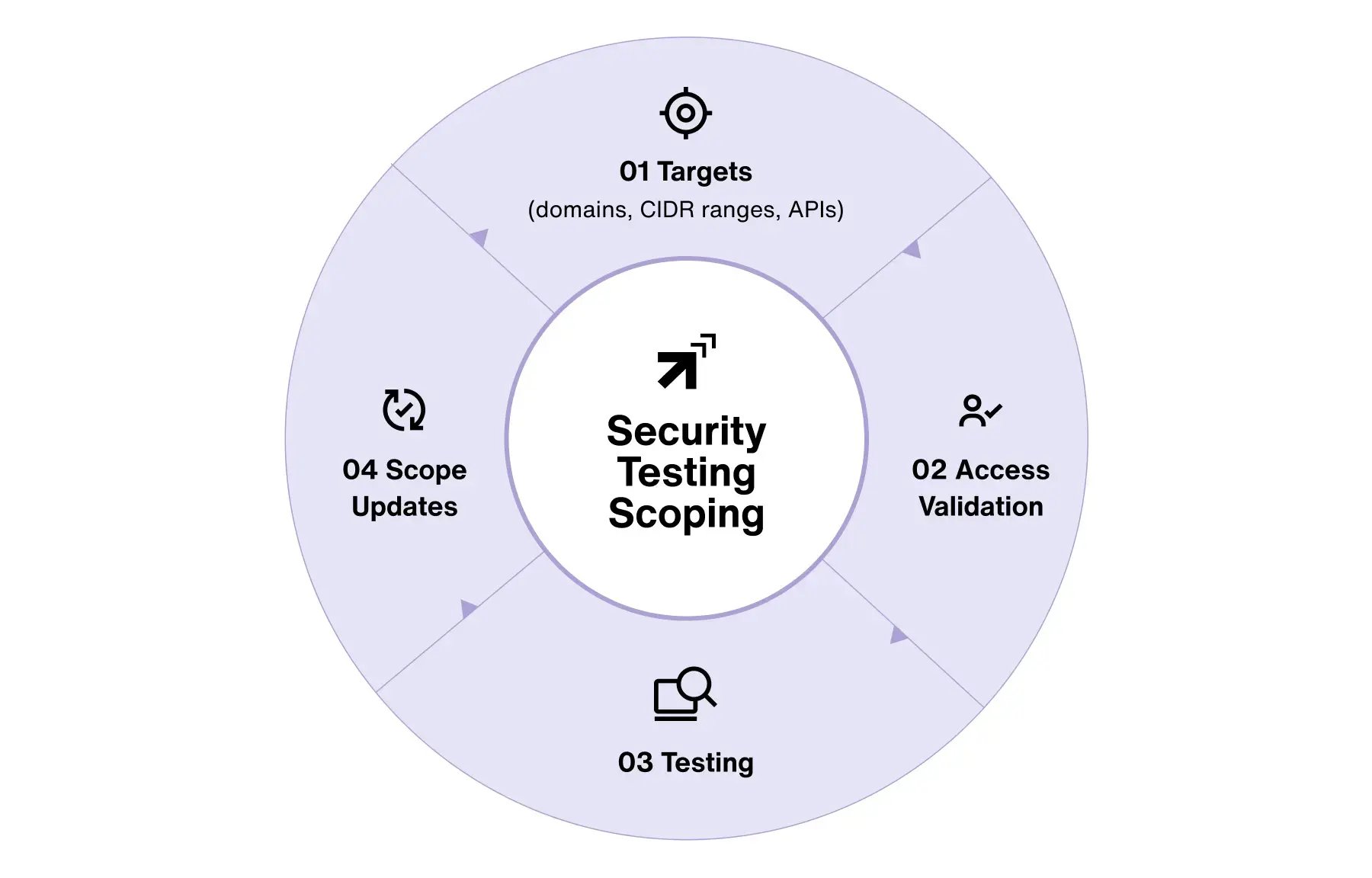
One misconception about scoping is that it is easily transmitted verbally, often during testing kick-off calls. In practice, having it customer-controlled, editable, and visible is very helpful.
When customers have the option to control their own scope directly—using clear, structured inputs—they:
This is particularly important for organizations with production systems that cannot tolerate ambiguity. Explicit definitions such as:
are far safer than loosely described scope statements buried in emails or PDFs.
Inspectiv’s approach is designed to support this model: customers (with the help of Inspectiv Customer Success, if desired) define the scope of a test, and keep it updated if it changes during a bug bounty program or test. That reduces both operational risk and friction with internal stakeholders.
The real challenge in scoping is not who defines it, but what information they have available when doing so.
Certain scenarios are especially prone to gaps:
In these cases, customers may not initially know:
Inspectiv expertise comes into play here—not by taking over scoping, but by helping customers cut through uncertainty. Through structured guidance, validation checks, and optional discovery assistance, teams can tighten scope iteratively without losing control. A super-common occurrence is when customers give us URLs or IP addresses that they can access but our testers cannot. We detect that very quickly.
Bug bounty programs magnify scoping quality—good or bad.
Poorly scoped programs often experience:
Well-scoped programs behave very differently:
Clear scoping also allows organizations to take advantage of pricing and efficiency benefits. When assets, IP ranges (including CIDR-defined blocks), and application boundaries are explicit, testing effort is spent on depth rather than discovery guesswork.
This directly lowers risk while improving return on investment.
One of the most practical benefits of precise scoping is traffic control.
Explicit scope definitions prevent:
By allowing customers to define scope down to concrete elements—domains, URLs, CIDR ranges, authentication states—testing stays where it belongs.
It’s important to note that in modern cloud environments, IP-based scoping can be occasionally unreliable because cloud providers frequently reassign public IP addresses and many services (e.g., CDNs, WAFs, PaaS platforms, shared load balancers) use multi-tenant infrastructure where a single IP may serve multiple customers. As a result, testing assets by IP address can inadvertently affect systems outside the intended scope.
For this reason, it is strongly preferred to define scope using URLs, domains, or customer-controlled subdomains rather than raw IP addresses. If IPs must be included, the client should confirm they are static/dedicated (e.g., Elastic IPs) and owned exclusively by them.
This is not just a security concern; it is an operational one.
Organizations that consistently get value from security testing tend to follow a few practical rules:
None of these require heavy process. They require clarity. Good security testing is about testing the right things, safely, clearly, and repeatedly.
Strong scoping makes that possible. To explore how Inspectiv can help with Scoping, and the rest of Security Testing, reach out to us at inspectiv.com/contact.
Ready to level up your AppSec program? Book a personalized demo to see how Inspectiv helps you uncover real risks, streamline workflows, and scale your security program through one unified platform designed to operate the way your team does.









.svg?width=32&height=32&name=icon%20(1).svg)
.svg?width=32&height=32&name=icon%20(2).svg)
.svg?width=32&height=32&name=icon%20(3).svg)