Platform
Explore Inspectiv’s AI-enabled platform that integrates Bug Bounty, Pentesting, Feature Testing, and VDP, designed to cut through noise and deliver signal-driven results.

.webp?width=1500&height=900&name=CISOs%20Prepare%20for%20Record%2050%2c000%20CVEs_%20Strategies%20and%20Insights_1000x600%20(1).webp)
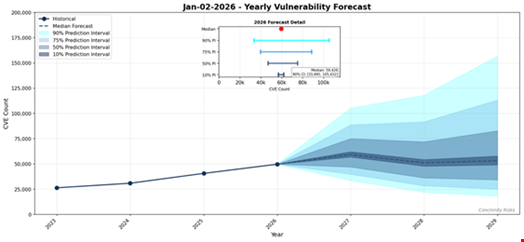
The cybersecurity industry anticipates a record surge in publicly disclosed software vulnerabilities, with projections exceeding 50,000 Common Vulnerabilities and Exposures (CVEs) in a single year. A new forecast from the Forum of Incident Response and Security Teams (FIRST) estimates a median of roughly 59,000 CVEs for 2026. Extreme scenarios could push this number as high as nearly 118,000, more than double the estimated 48,000 CVEs reported in 2025.
Despite the rising numbers, experts caution that the sheer volume of CVEs doesn't directly translate to increased risk. Michael Roytman, co-founder and CTO of Empirical Security, notes, “While the number of vulnerabilities goes up, what really matters is which of these are going to be exploited.” This highlights a growing signal-to-noise problem, straining security teams and emphasizing the need for better prioritization and automation.
Several factors contribute to the expected surge in CVEs. More organizations are operating as CVE Numbering Authorities, and more vendors are incentivizing disclosure through bug bounty programs. Additionally, previously neglected code bases, particularly in open source infrastructure, are now under increased scrutiny. This surge reflects improved visibility rather than a decline in software quality, with vulnerabilities that existed for years now being cataloged and tracked.
Inspectiv offers comprehensive Bug Bounty Management to help organizations proactively identify and address vulnerabilities.
FIRST adjusted its modeling approach to account for a structural shift in CVE publication that began around 2017. Éireann Leverett, FIRST liaison and lead member of the organization’s Vulnerability Forecasting Team, stated, "We think it’s entirely realistic that this year we reach 70,000 to 100,000 vulnerabilities," emphasizing that the median forecast is intended to support planning rather than alarm.
Experts emphasize that vulnerability volume alone is a poor indicator of enterprise risk. Roytman points out that the risk to an enterprise is not directly related to the number of vulnerabilities released. Data from 2025 shows that of roughly 48,000 vulnerabilities disclosed, fewer than 3,000 had publicly available proof-of-concept exploit code, and only about 700 showed evidence of exploitation in the wild. Many vulnerabilities affect niche software or consumer devices and are not relevant to large enterprise environments. Inspectiv analyzes each vulnerability to assign true severity beyond the standard CVSS metrics, to help organizations focus on vulnerabilities that pose the greatest risk.
The growing volume of CVEs presents significant challenges for security teams. FIRST estimates that approximately 5% of vulnerabilities account for most of the serious risk. Identifying this critical subset becomes increasingly difficult as the overall number rises. Leverett likens it to "finding a needle in the haystack," emphasizing the need to find the signal in the noise.
CISOs need to scale decision-making processes and improve prioritization, tooling, and automation. Security teams have been operating at a machine scale for years, and the rising noise floor exposes weaknesses in these areas. Inspectiv offers Penetration Testing services to help organizations identify and prioritize critical vulnerabilities.
While AI is accelerating vulnerability discovery, it is not yet leading to mass exploitation.AI-assisted tools are increasing the pace of vulnerability discovery, but exploitation remains constrained by economic and operational factors. Defenders are also using AI and machine learning to filter signal from noise, helping them determine which vulnerabilities are likely to matter and which can be deprioritized.
To manage the CVE flood, organizations should:
Inspectiv's comprehensive vulnerability management solutions, including Vulnerability Disclosure Program (VDP) Management, can help organizations manage the CVE flood effectively.
The forecast raises concerns about the sustainability of the vulnerability ecosystem, including MITRE, which produces CVEs, the National Vulnerability Database (NVD), and CVE Numbering Authorities (CNAs). Sasha Romanosky, a senior policy researcher at RAND, suggests the system is more likely to degrade gradually than collapse outright, with many vulnerabilities potentially being ignored.
This could shift more responsibility to software vendors and CNAs, who may face capacity constraints. Distributing more of the enrichment and prioritization work downstream may help in the short term, but only if automation improves. The result could be growing queues, uneven data quality, and greater reliance on private-sector tooling. Inspectiv provides comprehensive vulnerability management solutions to address these challenges and ensure organizations can effectively manage their security posture.
Is your organization prepared for the surge in CVEs? Contact Inspectiv today to learn how our comprehensive vulnerability discovery and management solutions can help you stay ahead of the curve.
Ready to level up your AppSec program? Book a personalized demo to see how Inspectiv helps you uncover real risks, streamline workflows, and scale your security program through one unified platform designed to operate the way your team does.











.svg?width=32&height=32&name=icon%20(1).svg)
.svg?width=32&height=32&name=icon%20(2).svg)
.svg?width=32&height=32&name=icon%20(3).svg)